







Blogs coloring page
10 Benefits of Coloring pages for Adults: What Science Says

The first time someone cried in one of my coloring workshops, I did not know what to do. She had arrived visibly tense, barely spoke to anyone, and spent forty minutes quietly working on a mandala. By the end of the session, she looked up and said it was the first time in weeks her brain had actually stopped worrying about her job.
I have witnessed variations of this exact scenario hundreds of times over the past eight years. People arrive with tight shoulders and racing thoughts. They pick up colored pencils, and their breathing changes before the page is even half finished. I do not need a heart rate monitor to measure it. The room goes quiet. Shoulders drop. Faces relax. You can see the actual Benefits of Coloring pages for Adults within the first twenty minutes. This practice provides legitimate adult coloring books mental health support. If you want to try it at home, I often send newcomers to ArtColoringPage.com to grab some printable coloring pages. You just need some paper and something to draw with.
Quick Answer: What are the benefits of adult coloring?
The practice of coloring repetitive patterns like mandalas lowers anxiety by quieting amygdala activity and slowing your heart rate. The routine also improves sleep quality when used as a screen-free evening habit and builds sustained focus for adults managing ADHD. The visual feedback loop provides immediate mental reward without demanding high-level executive function.
It reduces anxiety and proves the Benefits of Coloring pages for Adults
Not all coloring pages produce the same effect. I learned this early when I compared two workshop sessions side by side. One group worked on completely free-form patterns. The other group filled in structured mandalas. The mandala group left calmer every single time.
Koo, Chen, and Yeh published a study in 2020 that confirmed what I observed in my own room. Participants who colored mandalas showed significantly lower anxiety scores than those who did free-form drawing. The structured geometry seemed to anchor the mind rather than let it wander into stressful territory. You can find this study through the NIH database. I keep a printed copy on my workshop table for skeptics who think we are just playing with crayons.
The mechanism behind this involves the amygdala. That is the brain region that fires up when you feel threatened or stressed. Repetitive and symmetrical patterns appear to dampen that exact response. The activity gives the amygdala a low-stakes task to process. This simple task interrupts the loop of constant worry. Many people use coloring for stress relief precisely because the page holds their attention tightly enough so their nervous system can safely reset.
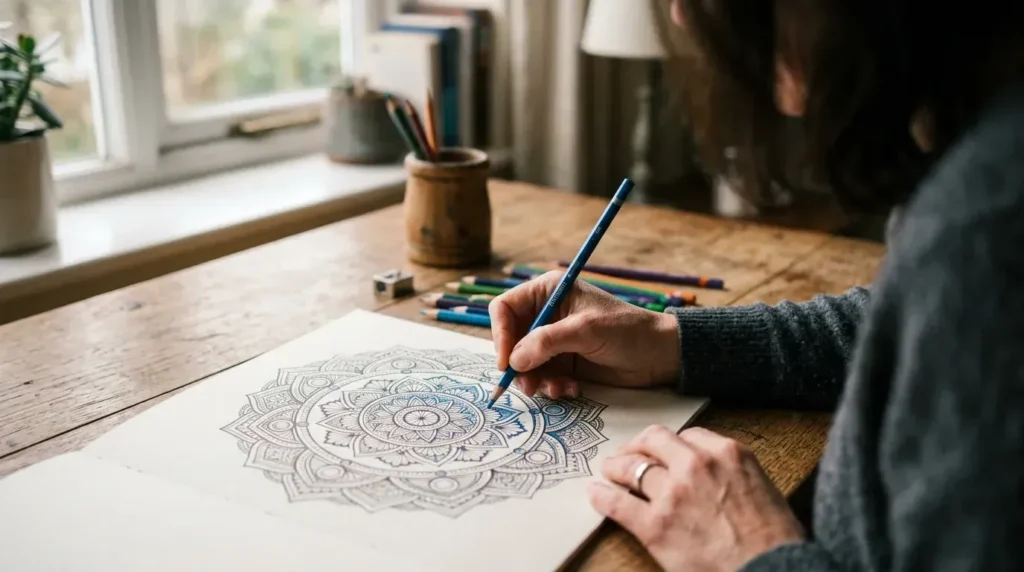
I have watched individuals with chronic adult coloring anxiety sit down with a geometric design and simply exhale after fifteen minutes. The white-knuckle grip on the pencil slowly loosens. If you want to experience real mandala coloring benefits, choose designs with clear sections and repeating shapes. The brain needs enough structure to engage with, but not so much that the image feels overwhelming. You can test this yourself with some basic designs .
It gives your brain what meditation gives it without requiring you to sit still
Many adults tell me they have tried meditation and failed completely. They cannot sit still. Their minds race faster when they close their eyes. They feel worse after ten minutes of silence because they spent the whole time berating themselves for not relaxing. I completely understand this frustration. Traditional seated meditation is not built for everyone. The assumption that you must sit motionless to calm down excludes a lot of busy brains.
The Cleveland Clinic describes adult coloring as an active form of meditation. You are not trying to empty your mind. You are filling it with one simple physical task. That difference matters immensely for people who find traditional meditation aggravating. The physical action gives the nervous system a concrete job, and that job becomes your anchor.
I see this constantly with coloring mindfulness adults who come to my workshops after quitting various meditation apps. They need something their hands can do while their thoughts settle. The back-and-forth motion of the pencil and the gradual filling of a blank space create a steady rhythm. That rhythm slows your breath without you having to force it. The body leads the mind into a state of rest.
You do not need a special cushion or a perfectly dark room to achieve this state. You only need a piece of paper and a wax pencil. The adults who benefit the most in my sessions are usually the ones who thought they were too restless for any kind of calming practice. The page meets them exactly where their energy levels are. You can burn off nervous energy through the pressure of the pencil, and eventually, the repetition slows you down.
It genuinely helps with sleep
I used to think evening coloring was just a nice wind-down ritual. Then I read the 2025 literature review by Gil on coloring before bed sleep, and the actual data changed how I run my programs. Gil found that individuals who colored on paper for thirty minutes before bed fell asleep faster and reported better overall sleep quality than those who used screens or did no activity at all. The review is recent. The pattern, however, perfectly matches what I have observed for years.
I now ask my regular attendees to track their sleep for a week after adding this habit. Most of them see a noticeable change by night three. The reason is heavily tied to blue light exposure. Phones and tablets emit wavelengths that actively suppress your natural melatonin production. Paper and pencil under a warm reading lamp do not emit those wavelengths. When you trade scrolling for shading, you remove the chemical signal that tells your brain to stay alert.
I tell workshop members to keep a page and a few colored pencils directly on their nightstand. Treat it as a hard boundary for the night. Do not touch your phone after you pick up the pencil. The thirty-minute window is incredibly specific and helpful. It gives your nervous system enough time to downshift without making the activity feel like a heavy chore.
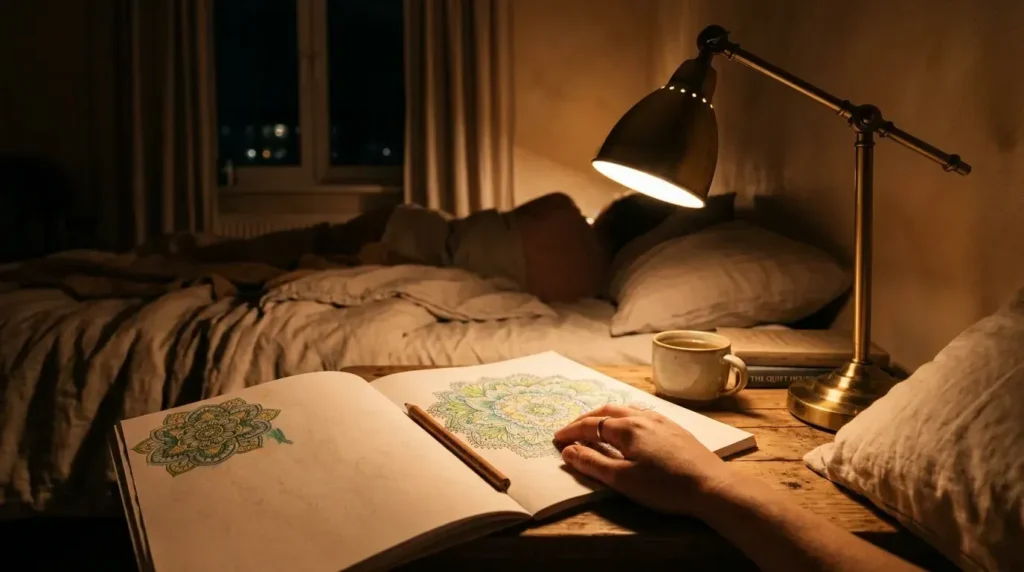
I strongly recommend paper and pencil only for this nighttime routine. Markers can bleed through the paper and create a mess that wakes you back up. A simple mandala or a repeating leaf pattern works best in the dark. The steady repetition primes the physical brain for rest. One woman told me she now associates the smell of cedar wood shavings from her sharpener with falling asleep. That physical sensory cue alone helps her body wind down.
It trains focus in a way most activities do not
Adults with ADHD often tell me they cannot focus on anything for more than five minutes. I hand them a simple geometric page, and something immediately shifts. The visual feedback loop is instant. You put down a color, and the page changes right in front of you. That immediate and tangible result holds the brain in a way that reading a book or listening to a podcast sometimes cannot.
The brain registers a tiny accomplishment and naturally wants to do the next bit. You can see this effect physically in the room. The foot tapping stops. The leg bouncing slows down. They lean their whole body into the table. For someone whose body is usually in constant motion, that sudden stillness is a genuine revelation.
This specific approach works beautifully as a form of coloring for ADHD adults because the task engages the prefrontal cortex without causing mental overwhelm. There is no abstract goal to decode. You are not solving a complicated problem for your boss. You are just matching a color to a defined space. The boundaries are already drawn for you, so you do not waste any executive function deciding where to start or what to build.
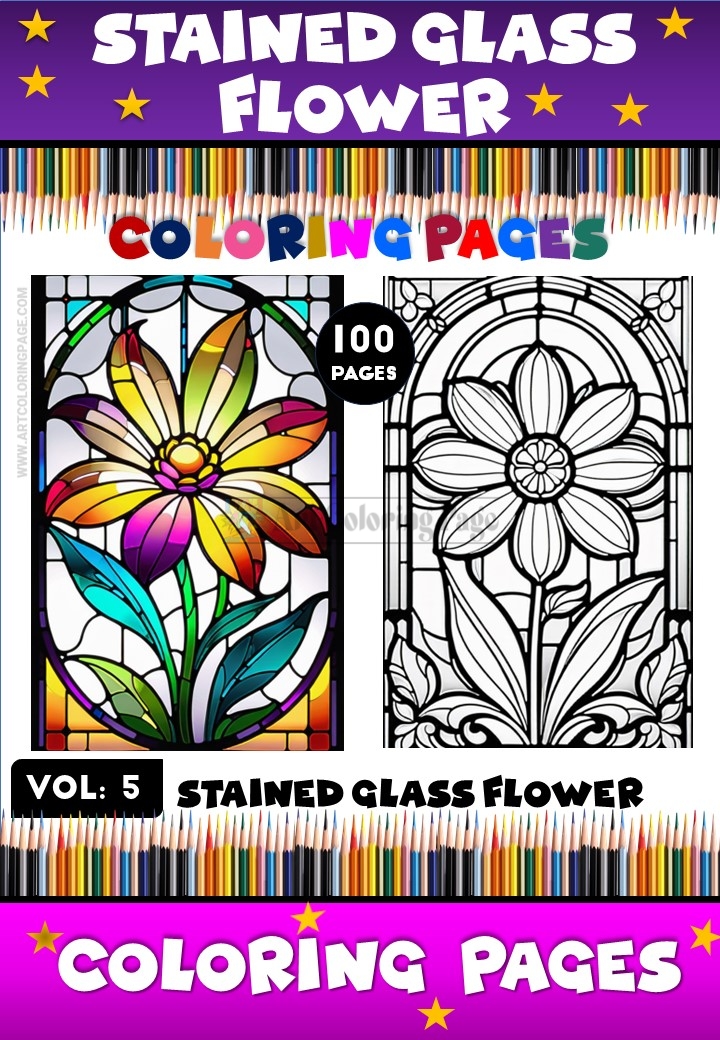
I often suggest checking out a for people who need very heavy structure. The thick and bold lines in stained glass designs create incredibly strong visual boundaries. The rhythm of scanning, choosing, filling, and repeating creates a predictable pattern. The brain can follow this track without anxiety. Many of my neurodivergent regulars say it is the only hour of the week their mind feels completely organized. The printed page externalizes the structure their brain struggles to build on its own.
It lets you process emotions without needing words
Girija Kaimal at Drexel University has studied art making and stress reduction extensively. Her published work clearly shows that the physical act of creating is what lowers cortisol, entirely independent of the quality of the final result. This detail matters deeply in my workshops. Half the adults who walk through my door believe they cannot draw a stick figure. They assume the mental benefit is reserved only for actual trained artists.
The therapeutic effect belongs entirely to the person holding the pencil, not to the finished page. People seeking therapeutic coloring adults often arrive with heavy grief or quiet anger they do not want to discuss with anyone. Severe occupational burnout is common among my attendees as well. The paper becomes a safe place to physically discharge that heavy emotional energy.
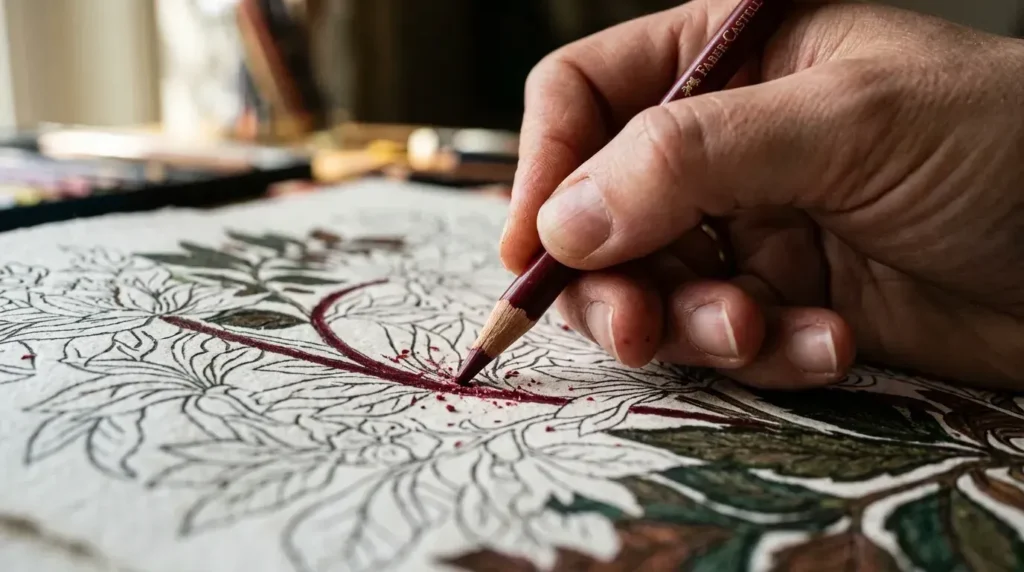
You can press hard with a dark red pencil until the graphite tip snaps. You can stay meticulously inside the lines or scribble right across them in frustration. The choice itself is a small and safe act of control in a life that might feel chaotic. Nobody grades your work at the end of the hour. Nobody even has to see it if you close the book.
Sometimes I provide pages and give zero verbal instructions to the room. The silence itself becomes part of the therapy. Adults who have to talk, manage people, and smile all day at work finally get permission to stop performing. The page does not ask how they feel or demand a coherent, polite response. It just accepts whatever marks they decide to make. I had a participant color completely in black for three straight weeks. She never explained why. On week four, she picked up a yellow pencil. The paper absorbed the transition so she did not have to explain it.
It builds creative confidence over time
Jason Conover is a licensed clinical social worker at Utah Valley Hospital. He talks frequently about the blank-page problem. This refers to the strict paralysis people feel when they face an empty canvas and believe they have absolutely nothing worth expressing. I see this exact paralysis every time I propose a free-hand drawing exercise in my sessions. Half the room freezes up instantly. Their hands hover nervously over the paper. They apologize out loud before they even make a single mark.
Structured coloring removes that barrier entirely. The lines are already printed there waiting for you. The decisions you have to make are much smaller and far less intimidating. You just pick a specific color. You fill a tiny space. You finish one small section. These tiny completions stack up quickly.
After a few weeks of this routine, adults who swore they were not creative start experimenting on their own. They blend two colors together to see what happens. They add light shading to the edges to create depth. They try a complicated stained glass design and realize they can actually make something they are proud to look at. The printed page becomes a safe practice ground for creative risk without any threat of public failure.
I had one man in his sixties who told me he had not made anything physical since a high school woodshop class. After six weeks of coloring geometric patterns with our group, he went out and bought a set of expensive watercolors. He said the coloring page taught him his hands still worked. That is the whole point of this exercise. You prove to yourself that you can start and finish something beautiful. That newfound confidence leaks into other areas of life.
FAQ : Benefits of Coloring pages for Adults
Is coloring as effective as meditation for stress relief?
The physical act produces similar neurological effects to seated meditation because both activities activate the parasympathetic nervous system. The Cleveland Clinic notes that structured coloring is a solid active alternative for people who struggle with traditional stillness. It actively lowers your heart rate and quiets mental chatter through repetitive physical motion rather than breath control alone. If traditional meditation has never worked for your brain, coloring is a highly valid and science-backed substitute.
How long does it take to feel the benefits?
Most people notice a physical shift within fifteen to twenty minutes of starting a page. Koo, Chen, and Yeh measured significant anxiety reduction after a single thirty-minute mandala session in their published 2020 study. Regular daily practice deepens this calming effect over time. My weekly workshop participants consistently report better sleep and sharper daytime focus after just two to three weeks of consistent coloring.
Do I need artistic talent to benefit from adult coloring?
You absolutely do not need any artistic talent to see physical results. Girija Kaimal at Drexel University found that cortisol levels drop regardless of a person’s prior artistic experience or skill level. The biological benefit comes directly from the act of making marks on paper, not from the aesthetic quality of the finished image. If you can hold a pencil and match a color to a blank space, you have all the skill required to lower your stress.
What designs are best for anxiety?
Mandalas and tightly structured geometric patterns work best for managing anxious thoughts. The 2020 study by Koo, Chen, and Yeh showed that mandalas reduced anxiety much more effectively than free-form drawing because the heavy symmetry contains the wandering mind. You should look for pages with clearly repeating shapes and distinct boundaries rather than wide open blank spaces. Medium detail is generally ideal, as too much complexity can overstimulate a nervous system that is already taxed.
Can coloring replace therapy or medication?
Coloring is a complementary tool and should never replace professional medical treatment. It can significantly lower your day-to-day stress levels, but it does not treat clinical depression or severe psychological trauma. Those serious health conditions require intervention from a trained clinician. I recommend coloring as a daily support practice to use alongside formal therapy. You should always talk to a medical provider first if you are struggling with severe mental health symptoms.
Pick one evening this week to try this yourself. Set a simple timer for thirty minutes, turn off your phone entirely, and color a single mandala with paper and colored pencils. That one small experiment will show you exactly how this works. When you are ready for proper designs, I highly recommend ArtColoringPage.com for their printable PDF collections in A4 format, from mandalas to stained glass, starting at $3.35. That simple habit unlocks the true Benefits of Coloring pages for Adults.